Crossword Tiles
An original crossword tile game: lay letter tiles on a 15 by 15 board, make words that cross, and score with the premium squares.
Play Crossword TilesFree. No sign-up needed to start.
What Crossword Tiles is
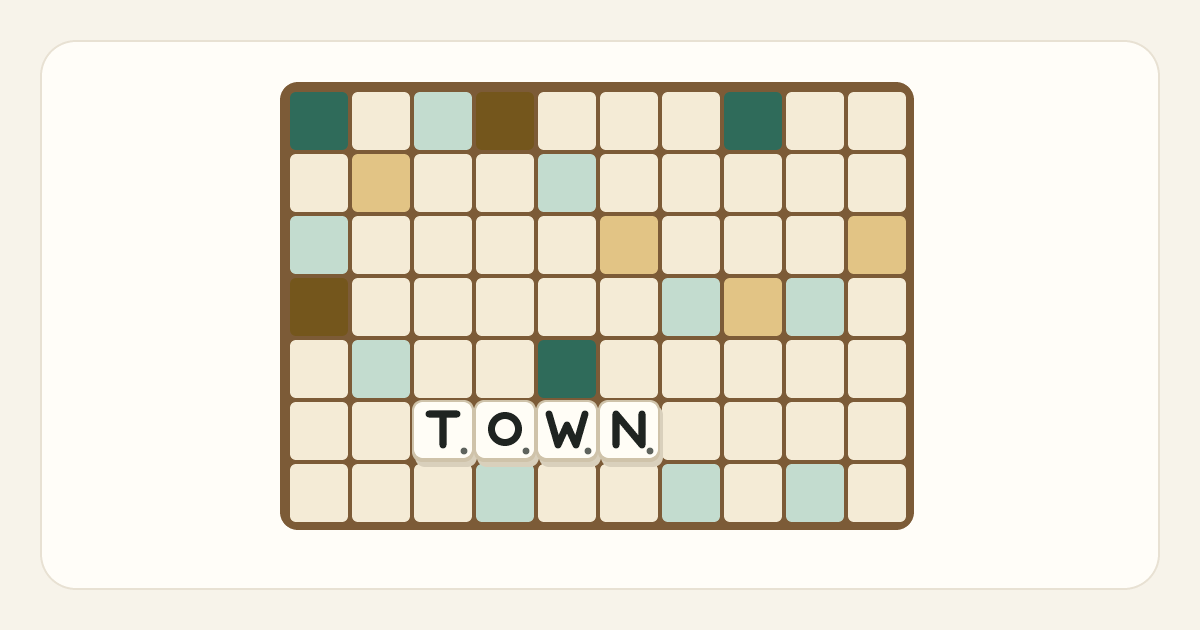
Crossword Tiles is an original word game for two to four players. Each player holds seven letter tiles and builds words on a shared board of 15 by 15 squares, so that every new word crosses or touches the words already there.
Each letter has a value, with common letters worth little and rare ones worth more, and coloured squares on the board multiply a letter or a whole word. The board, the number of each tile and their values were made for this game.
How to play
On your turn you can play tiles, exchange tiles or pass. To play, lay one or more tiles in a single row or a single column, with no gaps, so they make one main word. Any new tile that touches tiles along the other direction makes a cross word too, and every word you make must be in the word list. The first word must cover the centre square and use at least two tiles; every later word must touch a tile already on the board.
A word scores the value of its letters. A new tile on a letter square doubles or triples that letter, and a new tile on a word square doubles or triples the whole word. Squares count only in the turn they are covered. The two blank tiles stand for any letter and score nothing. Playing all seven of your tiles in one turn adds 50 points. After each turn you draw from the bag back up to seven.
An exchange swaps any of your tiles for new ones from the bag, needs at least seven tiles left in the bag, and uses up your turn. The game ends when the bag is empty and a player has played their last tile, or after six turns in a row that scored nothing. Each player then loses the value of the tiles left on their rack, and a player who went out gains the total of everyone else's. The highest score wins, and equal top scores are a draw.
Each turn has a time limit, two minutes unless the table chooses one or five minutes or none, and a turn that runs out of time passes. Friends can also turn on a house rule that allows any word, so the table decides and the word list is not checked.
Tips for your first games
Look for short words that reach a coloured square. A two or three letter word placed well can score more than a long word in the open. Words that cross on a high letter, so the letter counts in both words, are a good habit.
Keep a mix of vowels and consonants on your rack, and exchange when it is all of one kind.
Getting better
Think about what you open up. A word that leaves a triple word square easy to reach is a gift to the next player. Learning the two letter words in the list makes it much easier to squeeze tiles in beside other words.
Save useful tiles such as a blank or an S for a bigger play, and aim now and then for a play of all seven tiles, worth 50 extra points. Near the end, count the tiles left and play out first if you can.
A short history
The oldest known Sator square, a grid of five Latin words that read the same across and down, was scratched on a column in the Roman town of Pompeii before AD 62. English word squares, grids whose words read the same across and down, grew slowly: 6-letter words in 1859, 7 in 1877, 8 in 1884 and 9 in 1897. The puzzle usually called the first crossword appeared in the New York World newspaper on 21 December 1913. Its maker, Arthur Wynne, called it a word-cross.
A few weeks after the first word-cross puzzle, a typesetting slip swapped the name around to Cross-Word, and the new name stuck. Crosswords became a craze in the 1920s. Critics grumbled that they wasted time, but by 1925 many newspapers were printing them.
Sources for this history
Playing Crossword Tiles on Magem Mind
In Magem Mind you can play Crossword Tiles against the computer at easy, normal or hard, or pass one phone around a group. You can check whether a word is in the list, and look up the meaning of a word that was played.
Online, play friends with a code you share, two to four players, or a quick match. Crossword Tiles can also be played over days with friends, with one or three days for each move. A short lesson you play along with teaches placing tiles, scoring, premium squares, blanks and exchanging, and every game is played purely for the win.