Ludo
Roll, race your four tokens round the board, and bring them all home first.
Play LudoFree. No sign-up needed to start.
What Ludo is
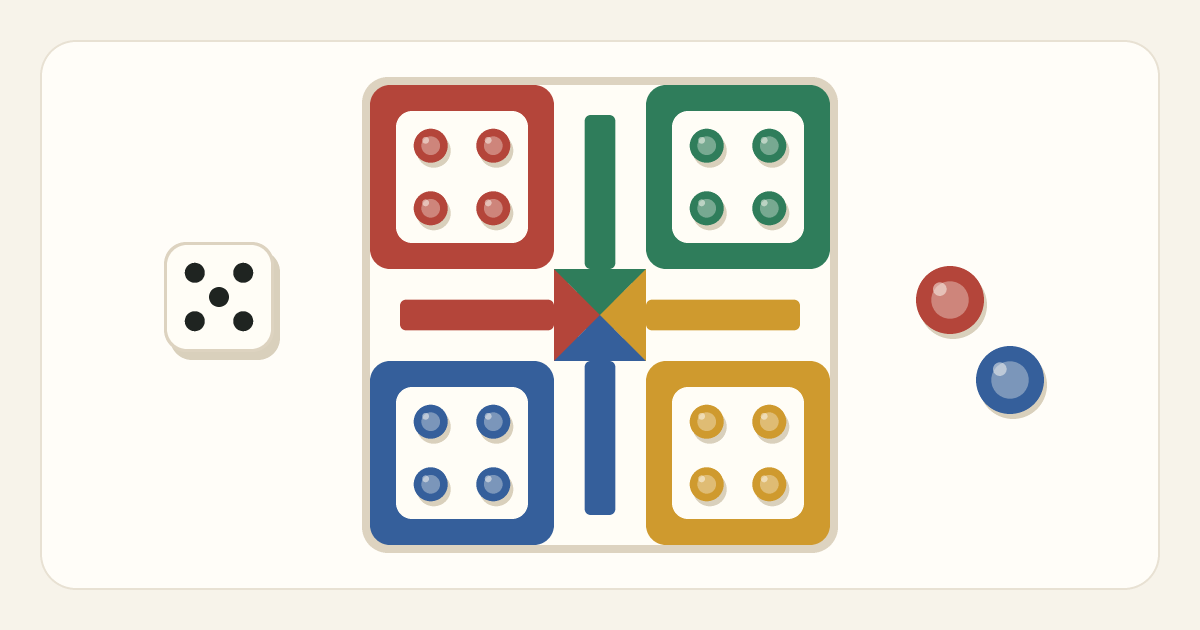
Ludo is a race game for two to four players. Each player has four tokens waiting in a yard in one corner of the board, and the goal is to bring all of them round the board, up their own coloured home column and into the centre before anyone else does. The dice decide how far you go, but your choices decide who gets home first.
It is a game the whole family can share. The rules take a minute to learn, a round is full of small surprises, and sending someone back to their yard is part of the fun.
How to play
Magem Mind plays Ludo with two dice, the way it is played across Nigeria. Roll a six to bring a token out of the yard. Each die is its own move: use both dice on one token, or one on each of two tokens. The dice are never added up to make a six, so a 3 and a 3 is two moves of 3. When a move can be made with a die, it must be made, and a die no token can use is lost.
A double six rolls again. Three double sixes in a row end your turn. While every token of yours is still in the yard, you get three tries for a six.
Land on another colour, on any square, and that token goes back to its yard. Passing over a token is not a capture, and your own tokens and your partner are never captured. Two of your tokens on one square do not block the way. A capture earns another roll, and so does getting a token home, though one turn earns at most one extra roll. You need the exact number to finish. With two players, each of you runs two colours in opposite corners and wins once both are home.
House rules let your table play its own way. Play with one die, where any six rolls again. Come out on a one or a six. Turn on safe squares, so the marked squares and start squares protect a token. Make capturing compulsory when it is possible. Play with two tokens each for a quick game, or in teams of two with partners sitting opposite. The other bonus rolls and the three sixes rule can each be switched off.
Tips for your first games
Bring tokens out early, so that each roll has more than one good use. Try not to stop just in front of another colour, where a short roll can reach you, and remember that the home column is safe once you are in it.
Getting better
Think about both dice together before you move. Often the strongest play uses one die to capture and the other to run a token out of danger. Keep a token near your start square to guard it, and when the others are close to home, slow them down with a capture rather than racing on alone.
A short history
Instead of dice, pachisi players threw six or seven cowrie shells and counted how many landed with their openings facing up. The games historian Irving Finkel calls the great pachisi courts of the Mughal emperor Akbar, who ruled in the 16th century, the first real evidence of the game. Akbar's court historian, Abu'l Fazl, wrote that pachisi matches at the Mughal court could go on for days.
When pachisi became Ludo in England, a small cube die shaken in a cup took the place of the cowrie shells that players threw in India. The first Ludo tokens were flat discs of bone. Later sets used cardboard, and today most are plastic. In 2022, at least 100 players met at Teslim Balogun Stadium in Lagos for the first Nigeria Ludo Championship, from artisans to students and civil servants.
Playing Ludo on Magem Mind
In Magem Mind you can play Ludo against computer players at three levels, easy, normal and hard, with two to four seats. You can play friends online with a code you share, or pass one phone round the room. The dice for an online table come from the server, never from a player.
A short lesson you play along with teaches the rules, and it follows the house rules of your table. Every game is played purely for the win.