Mind games
Short games for memory and focus, with rounds of logic puzzles and riddles.
Play MindFree. No sign-up needed to start.
What Mind is
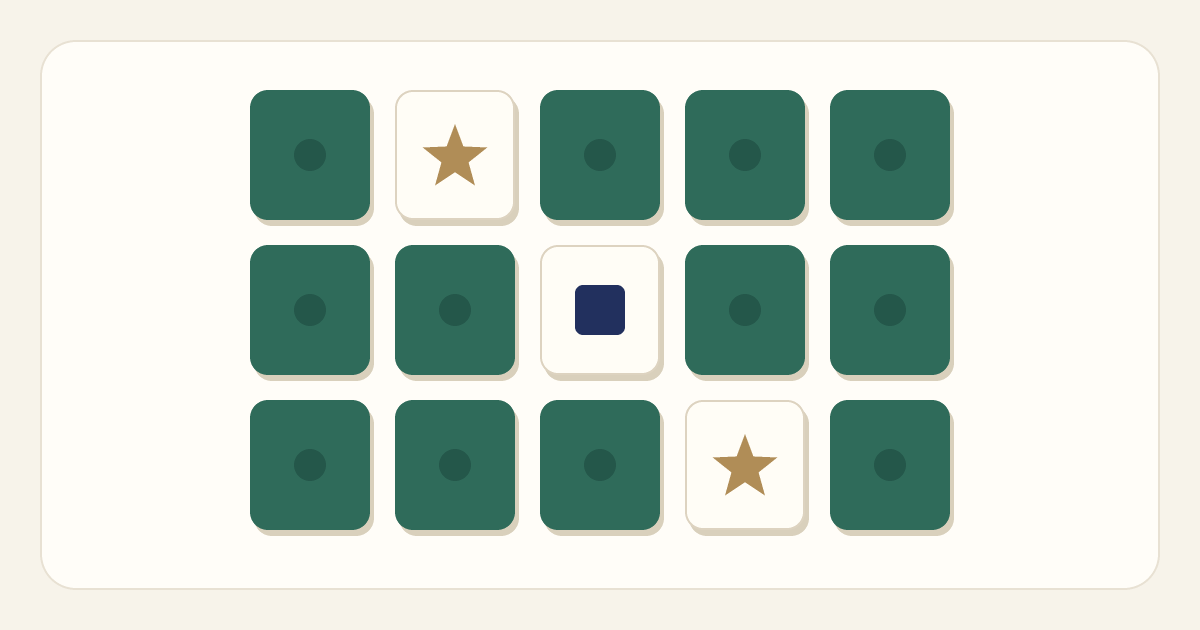
Mind is a set of five short games for memory and focus: Pairs, Recall, Sequence, Numbers and Spot. Each one takes a few minutes, uses the same calm Mahjong tiles you see across Magem Mind, and asks for nothing more than your attention. They suit a quiet break, a wait for the bus, or a few minutes before sleep.
Every game adapts to you. It starts at your level, and each result moves that level up a little after a good game, down a little after a hard one, or keeps it where it is. Nothing is timed against you.
How to play
Pairs: turn tiles over two at a time and find every pair. A slip is a miss you could have avoided, such as missing a match when you had already seen where the partner tile was. A first look never counts. Find them all with few slips to move up a level.
Recall: a group of tiles lights up together. Watch, then tap the same tiles back, in any order. Each right answer adds a tile, and two misses in a row at one size end the game.
Sequence: tiles light up one after another, each with its own note. Watch and listen, then repeat the order. Get it right and the same order comes back one step longer. A miss plays it once more, and two misses in a row end the game.
Numbers: digits show one at a time. Remember them in order, then type them back. Delete takes a digit back, and the answer is checked once it is complete. Each right answer adds a digit, and two misses in a row end the game.
Spot: find the tile shown at the top among many others. Ten finds make a game. There is no countdown, and a wrong tap adds one second to your time. Higher levels bring more tiles, and more that look alike.
Tips for your first games
Begin with Pairs, which feels the most familiar. Say what you see quietly in your head, such as three bamboo, top left, so a tile has a name and a place. In Recall, look at the shape the lit tiles make together rather than at each one.
Getting better
Split long runs into small groups. Six digits are easier to hold as two sets of three, and a long sequence is easier as a tune. Play at about the same time each day, rest when your attention fades, and let the level settle on its own instead of pushing it.
A short history
The German psychologist Hermann Ebbinghaus spent years testing his own memory. He published the results in 1885 in a book called On Memory. In 1956 the psychologist George A. Miller published a famous paper called The Magical Number Seven, Plus or Minus Two, about the limits of short-term memory. The American TV game show Concentration, based on the pairs memory game, ran on NBC from 1958 to 1973, with 3,770 shows. Hidden behind its board was a picture puzzle.
The electronic memory game Simon came out in 1978. Its four coloured buttons light up and play tones in a sequence that grows longer each round. Kim's Game, where you study a tray of objects and then list them, is named after Rudyard Kipling's 1901 novel Kim, in which the boy hero learns it. In Yoruba moonlight storytelling, riddles called àlọ́ àpamọ̀ come first, to wake up the listeners, before the folktales called àlọ́ àpagbè.
Playing Mind on Magem Mind
In Magem Mind you play the Mind games on your own, at any time, and they work offline once the app is on your device. The first time you open each game, a short lesson you play along with shows how it works, and you can open it again from How to play.
Under More you can also start a round of riddles or a round of logic puzzles, which are played as Trivia rounds. Your level and your top results in each game are kept, so you can see yourself improve. Every game is played purely for the win.