Mahjong for four players
The classic game for four: draw and discard, call chow, pung and kong, and complete a winning hand before the others do.
Play MahjongFree. No sign-up needed to start.
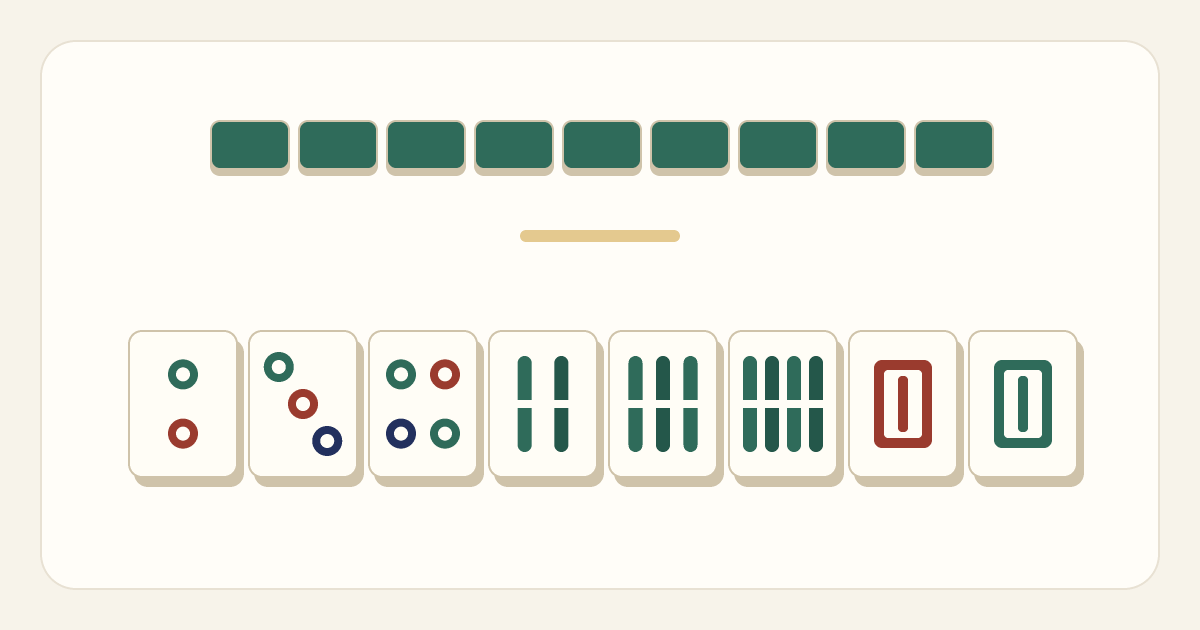
What Mahjong is
Mahjong is a game for four players built from tiles instead of cards. Each player holds a hand of tiles, and the aim is to turn that hand into a complete set of groups before anyone else. It is a game of small decisions: which tile to keep, which to let go, and when to claim a discard.
Magem Mind plays the Hong Kong style, often called Hong Kong Old Style. The set has 144 tiles: three suits of dots, bamboo and characters numbered one to nine, the four winds, the three dragons, four of each, plus four flowers and four seasons. A hand is scored in faan, and faan turn into points from a published table.
How to play
Everyone takes 13 tiles. The dealer, who sits as East, takes a 14th and plays first. On your turn you draw a tile from the wall and discard one, so your hand always comes back to 13. Flowers and seasons never stay in a hand: they are laid face up at once and a replacement tile is drawn for you.
The tile just discarded can be claimed. The next player may take it for a chow, three in a row of one suit. Anyone may take it for a pung, three of a kind, or a kong, four of a kind, or to win. A win beats a pung or a kong, and those beat a chow. Four of a kind in your own hand can be laid down as a kong on your turn, and you draw a replacement tile.
A winning hand is four sets and a pair, or the special hand of thirteen orphans. The game only offers the Win button when a hand really is complete and worth enough faan, so there is never a false win. When the wall runs out with no winner, the hand is a draw. Points are only ever added to the winner, never taken from anyone.
Before a game you can set the house rules: a match of four hands, where everyone deals once, or a full East round; the faan needed to win, none, 1 or 3; and whether to play with the flowers and seasons.
Tips for your first games
In your first games, aim for simple hands. Chows are the easiest sets to finish, because many tiles can complete them. Let go of single winds and dragons early unless you already hold two of the same, since they cannot join a chow.
Watch the discards. A tile others have just thrown away is a safer discard, and a suit nobody discards may be one an opponent is collecting.
Getting better
As you get better, plan for value as well as speed. A hand of one suit with winds or dragons, or a hand of all pungs, is worth far more faan than a hand of chows, but it takes longer and shows your plan when you claim tiles.
Claiming is a trade. Every chow or pung you take from a discard lays tiles face up and tells the table what you need, and it costs the faan for a concealed hand. Count the tiles you can see: if three of a tile are already out, the fourth is a poor tile to wait for.
A short history
Mahjong as we know it took shape in China in the middle of the 19th century, when older card games were turned into games played with tiles. Mahjong grew out of older Chinese card games where you draw a card and throw one away. Those cards had money suits called Cash, Strings and Myriads. The oldest surviving mahjong sets, from around 1870, were collected in three Chinese cities: Fuzhou, Shanghai and Ningbo.
Mahjong was popular in Shanghai in the late 1800s. By about 1900 it was even played in the royal palace in Beijing. In 1920 Joseph Park Babcock wrote Rules of Mah-Jongg, known as the red book. His simpler rules helped English speakers learn the game.
Sources for this history
Playing Mahjong on Magem Mind
In Magem Mind you can play Mahjong against three computer players at easy, normal or hard. The computer only knows what a person in its seat would know: its own tiles and what lies face up. You can also open a table for friends online and share its code. If someone steps away, a computer plays their seat until they come back.
A short lesson you play along with shows sets, claiming a discard, kongs and what a hand is worth, in about three minutes. After a won hand, the table lists every faan it scored, so you learn the values as you play. Every game is played purely for the win.