Spades
The partnership trick taking game: say how many tricks you will take, then make them together.
Play SpadesFree. No sign-up needed to start.
What Spades is
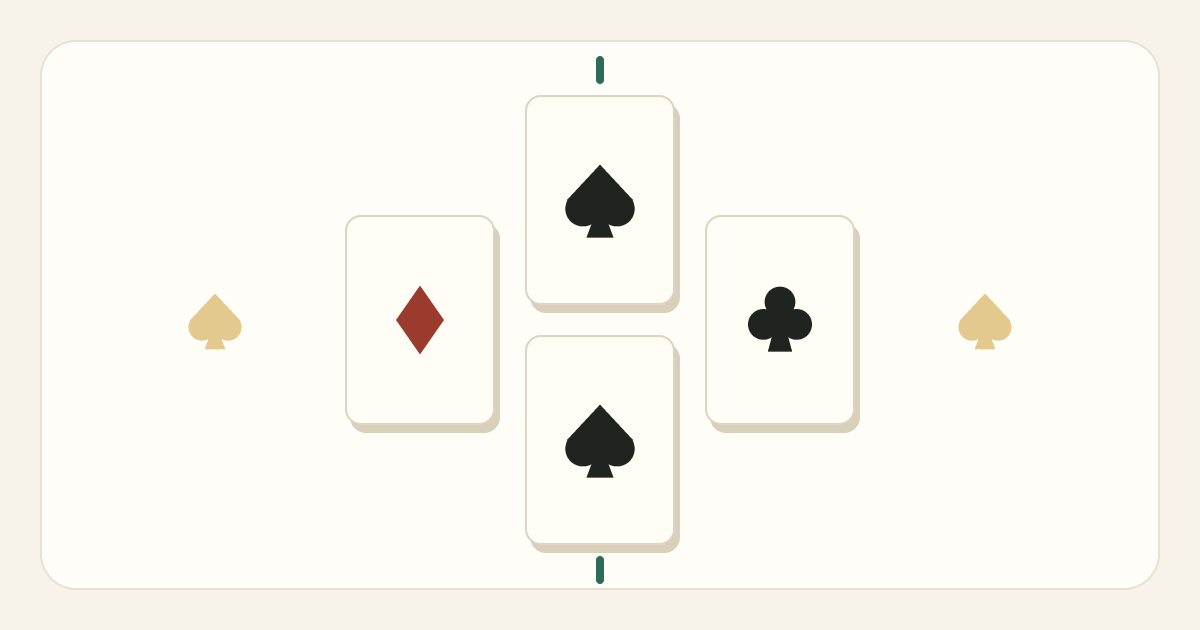
Spades is a trick taking card game for four players in two partnerships, with partners sitting across the table from each other. Before each hand, every player says how many tricks they expect to win. Then the partners work together to make their number, with spades always ranking above every other suit.
It is a game of honest estimates and good teamwork. A hand that looks ordinary can be worth a lot with the right partner, and a team that promises too much, or wins far more than it said, pays for it on the score sheet.
How to play
All 52 cards are dealt, thirteen each. Starting after the dealer, each player bids the number of tricks they think they will take, from 0 to 13. A partnership adds its two bids together, and that total is the team contract for the hand. The deal moves round the table each hand.
The player after the dealer leads the first trick. Everyone must follow the suit that was led if they can. A player with none of that suit may play any card, and a spade wins the trick unless a higher spade is played. Spades cannot be led until a spade has been played, unless a player holds nothing but spades.
A team that makes its contract scores 10 points for each trick it bid, plus 1 point for every extra trick. Those extra tricks are called bags, and every ten bags a team collects costs it 100 points. A team that falls short loses 10 points for every trick it bid.
A bid of nil is a promise to take no tricks at all. Keep it and your team gains 100 points; take even one trick and it loses 100. Tricks taken by a nil bidder never help the partner, and they count as bags. Nil is on unless the table turns it off. The first team to reach the target, 500 or 250 points as the table chooses, wins.
Tips for your first games
Count your sure tricks before you bid: high spades, aces and kings in suits where you hold a few cards. A low spade can also win a trick when you run out of another suit. It is usually safer to bid a little low than to promise one trick too many.
Listen to your partner. Their bid tells you how strong their hand is, so you can decide whether to try to win a trick yourself or leave it to them.
Getting better
Mind the bags. Once your contract is safe, try to lose the tricks you do not need, by playing under the winning card. And when the other team is close to ten bags, you can push extra tricks onto them.
Protect a partner who bid nil. Lead high in suits where they may be stuck, win the tricks they would otherwise take, and keep your own high cards for that job. When an opponent bids nil, do the opposite and lead low cards they may have to win.
A short history
Spades belongs to the Whist family of trick-taking games, and is closely related to Bridge, Pinochle and Euchre. In 1742 Edmond Hoyle published a short book on Whist, the game behind Spades. Its rules were the standard guide for about a century. Spades is said to have been developed in the Midwest of the United States in the late 1930s.
Bridge writer George Coffin traced the start of Spades to Cincinnati, Ohio, sometime between 1937 and 1939. Spades is said to have spread with American soldiers in the Second World War, who liked a simple game they could stop and restart easily. After the Second World War, Spades is said to have spread among college students, as many returning soldiers went to study.
Before a Spades game starts, players often agree house rules, such as the winning score, which is often 250, 300 or 500.
Playing Spades on Magem Mind
In Magem Mind you can play Spades with a computer partner and two computer opponents, at easy, normal or hard. The computer plays only from what a real player could know. A group can share one phone too, with computer players in any seat that is left.
Online, play friends with a code you share, or join a quick match where computer players take any empty seat. Before a game with friends you can choose the target score and whether nil bids are allowed. A short lesson you play along with teaches bidding, trumps, nil and bags, and every game is played purely for the win.