Solitaire
Klondike, the solitaire most people know: build the four suits from ace to king.
Play SolitaireFree. No sign-up needed to start.
What Solitaire is
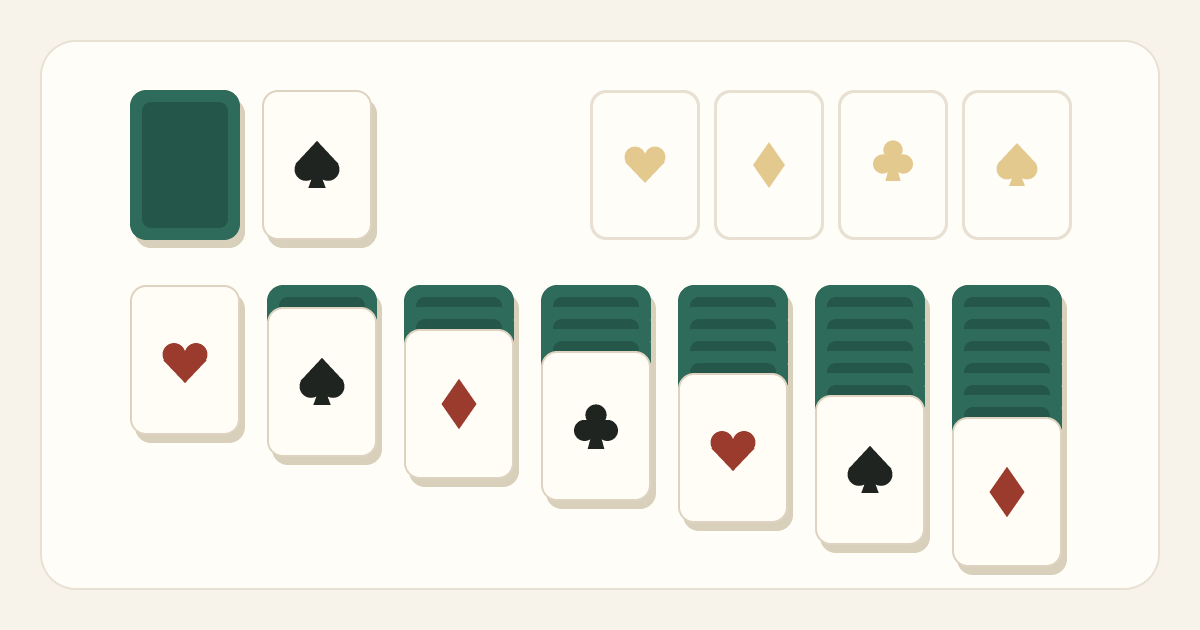
Solitaire, also called patience, is a card game you play on your own. The version in Magem Mind is Klondike, the one most people picture when they hear the word: seven columns of cards, a stock to draw from, and four foundations to fill.
The aim is to move all 52 cards up to the foundations, one suit on each, from ace to king. Some deals open up quickly and some need careful thought. That mix of calm and puzzle is why so many people keep a game of solitaire close at hand.
How to play
The deal lays out seven columns of one to seven cards. Only the last card of each column is face up. The other 24 cards form the stock.
In the columns you build down in alternating colours, so a black six goes on a red seven. You can move any face up run of cards together. When a face down card is uncovered, it turns over. Only a king, or a run headed by a king, may go into an empty column.
Each foundation starts with an ace and then goes up in the same suit, one card at a time. A card on a foundation can come back down to a column if you need it there.
Tap the stock to turn cards over. You can draw one card at a time, or three for a harder game, where only the top card of the three is in play. When the stock is empty, the turned cards go back over in the same order, as often as you need. You win when all 52 cards are up. Once every card is face up and the stock is used, Finish plays the rest for you.
Tips for your first games
Turning over face down cards matters more than anything else. When you have a choice, make the move that uncovers a hidden card, and start with the longest columns, where most cards are hidden.
Move aces and twos up as soon as they appear. Other cards are often more useful in the columns for a while, where they can hold the next card down.
Getting better
Empty a column only when you have a king ready to fill it. An empty column with no king to place is a space nobody can use.
Before moving a card to a foundation, ask whether a card of the other colour might need it as a place to land. Look ahead in the stock too: in draw three, every card you play from the turned cards changes which cards you can reach on the next pass. Undo is there to test an idea, and good players use it to learn.
A short history
The earliest safe date for patience, card games for one, is about 1758. It comes from a biography of the German composer Carl Friedrich Fasch, written in 1801. Patience is probably German or Scandinavian in origin. Its earliest records come from the late 1700s and early 1800s. Patience became popular in France in the early 19th century, then spread to Britain and America in the second half of that century.
The earliest known rules of Klondike, the best-known patience, appeared in 1907 in Hoyle's Games, under the name Seven-Card Klondike. In 1913, a rule book called Official Rules of Card Games shortened Seven-Card Klondike to plain Klondike, with the pack turned one card at a time. Microsoft Solitaire was written in the summer of 1988 by Wes Cherry, a student intern at Microsoft.
Solitaire came with Windows 3.0 in 1990 and helped many people learn to use a mouse, because moving the cards means dragging and dropping them.
Playing Solitaire on Magem Mind
In Magem Mind you can play as many deals as you like, in draw one or draw three, and choose to be dealt only deals that can be cleared. Every day there is also a daily deal, the same for everyone, in draw one. Your time and moves are checked, and the first clear of the day is ranked.
With friends, start a race: everyone gets the same winnable deal at the same moment, and the first checked clear wins. You can also send a challenge with your time on a deal. A short lesson you play along with teaches foundations, columns, the stock and kings in about two minutes.