Go
The ancient board game of territory: place stones, surround space, and capture what you can cut off.
Play GoFree. No sign-up needed to start.
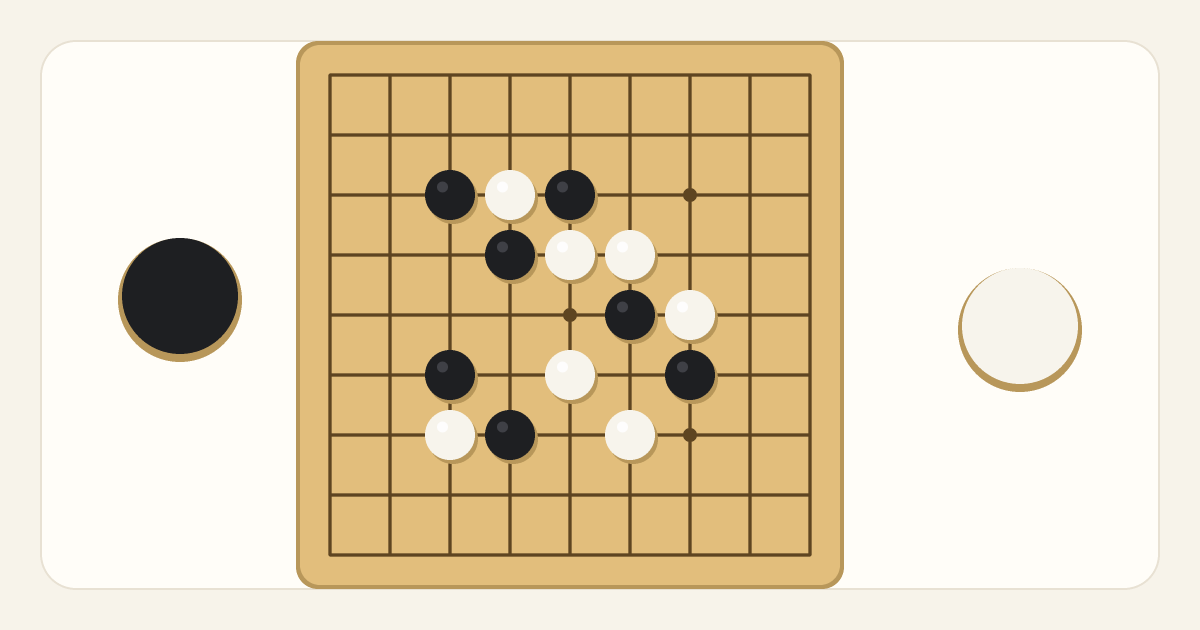
What Go is
Go is a board game for two players, Black and White, who take turns placing stones on the points where the lines of a grid cross. Stones never move once they are down. Little by little the board fills with walls and groups, and the player who surrounds more of the board wins.
The rules fit in a few sentences, yet the game is deep enough to last a lifetime. It rewards patience, a calm eye for the whole board and the courage to let go of a small gain for a larger one.
How to play
Black plays first. On your turn, place one stone on any empty point, or pass. The empty points next to a stone are its liberties, and stones of one colour that touch along the lines form a group that shares them. Take the last liberty of a group and it is captured and lifted off the board. You cannot play where your stone would have no liberties, unless that move captures.
A move may not bring back a board position that has already appeared in the game. This covers ko, where two players could otherwise take a single stone back and forth for ever: you must play elsewhere first. A group with two separate eyes can never be captured.
When both players pass in a row, play ends and the board is counted. The game suggests which stones are dead, either player can tap a group to change that, and the score stands when both accept. If you read the board differently, you can keep playing and settle it with stones. Magem Mind uses area scoring by default, stones plus surrounded empty points, with 7.5 points to White for moving second. Territory scoring, surrounded points plus captures, gives White 6.5. Boards are 9 by 9, 13 by 13 or 19 by 19.
Capture Go is the beginner's game: the first player to capture a stone wins. It is the gentlest way to learn how liberties work.
Tips for your first games
Start on the small 9 by 9 board and play a few games of Capture Go. Then, in the full game, place your first stones near the corners, where it is easiest to make territory. If one of your groups is down to one liberty, called atari, add a stone to give it more room or let it go and play somewhere bigger.
Getting better
Try to make two eyes for every group you want to keep, and look for opponent groups that cannot. Do not chase every capture: a stone that is weak can often be left while you take a larger area. After each game, use the review to see which moves changed the score the most, and try a larger board once the small one feels familiar.
A short history
The oldest written mention of Go is usually traced to the Zuo Zhuan, an ancient Chinese history book, in a story about an event from 548 BC. Go is mentioned in Book XVII of the Analects of Confucius, and the philosopher Mencius wrote about it too, more than 2,000 years ago. Go was one of the four arts expected of a cultured Chinese scholar: qin (a stringed instrument), qi (Go), shu (calligraphy) and hua (painting).
The earliest 19 by 19 Go board yet found is a ceramic one from the Sui dynasty (581 to 618), dug up at Anyang in Henan, China. Go reached Korea sometime between the 5th and 7th centuries. There it became known as baduk, the name Koreans still use. Go arrived in Japan by the 7th century. The Taiho Code, a set of Japanese laws from 701, already describes the game.
The video game company Atari, founded in 1972, took its name from the Go word atari. Co-founder Nolan Bushnell enjoyed playing Go.
Sources for this history
Playing Go on Magem Mind
In Magem Mind you can play Go against the computer at three levels, easy, normal and hard, or play a friend online with a code you share or on one phone. Online you can play live, or over days, with one, three or seven days for each move, so a game can fit around school and work.
A short lesson you play along with teaches liberties, capture, ko and two eyes. You can show a soft glow on groups that are down to one liberty, and after a game a review shows the key moments where the game turned. Every game is played purely for the win.